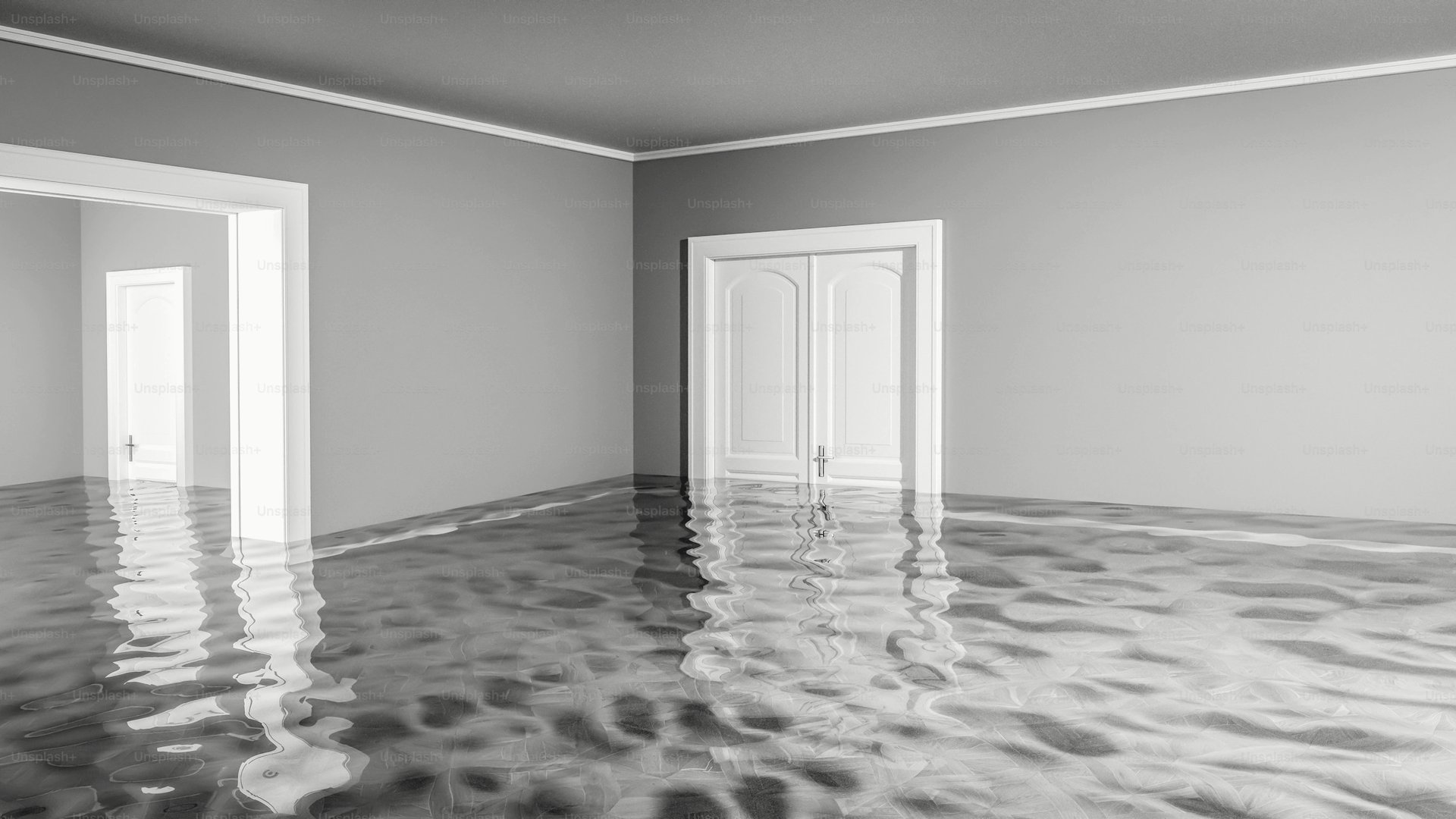
It was a Sunday evening in Hancock Park — a 1950s six-unit courtyard, second floor, supply line to the bathroom vanity. The tenant called at 6:47 p.m. By the time a key got turned in the front door, water had been running for roughly eleven minutes. The unit below had a wet ceiling. The hardwood in the bathroom had already started to cup. The bill, all-in, was $38,000. The same failure caught at four minutes would have been a $3,200 plumbing repair and a half-day of drying. The gap between those two numbers is not the pipe. It is the eleven minutes.
A burst supply line releases 4 to 8 gallons of water per minute. In fifteen minutes that is 60 to 120 gallons moving through whatever is in its path — subfloor, framing, the ceiling cavity of the unit below. The water you can see on the floor is rarely the problem. The water you cannot see, already drawn into the wall cavity and pooling above the dropped ceiling, is what drives a $40,000 claim. Mold follows wet framing within 48 to 72 hours in the warm-side months of an LA building, and mold remediation on a courtyard building is never a small line item.
What follows is the sequence we use. It is not generic advice. It is the protocol we have walked on our own buildings and handed to property managers on buildings we run for others.
The water you can see is only half the problem. The water you can't see — soaked into drywall cavities and under the subfloor — is what doubles the bill.— Field note, plumbing crew, March 2026
Stop the water first.
Every second the supply line runs, more water migrates into structure. Closing the main shutoff is the only action that matters in the first sixty seconds, and on most Westside LA buildings there are three places to look for it: in a concrete box near the sidewalk by the street, on an exterior wall adjacent to the water heater, or in the garage. Turn it clockwise until it stops. If the main is seized — old gate valves seize — go to the water meter at the curb. You need a meter key, which is a T-shaped tool that costs about $10 at any hardware store and should be in the building's emergency kit.
One caveat that gets missed: if the burst is near an electrical panel, outlets, or switches, do not touch the shutoff through standing water. Go to the main breaker first, kill power to the affected zone, then close the water. The sequence matters because water and a live panel is a worse emergency than the pipe alone.
On a multifamily building where the tenant may not know the valve location, this is the single strongest argument for laminated emergency cards in every unit — one page, valve location diagram, your emergency line. We print them and tape them inside the kitchen cabinet under the sink on every building we manage. The card has saved us the equivalent of its printing cost many times over.
Document before you touch anything.
Once the water is off, resist the instinct to start mopping. Spend three to five minutes taking photographs and video of exactly what you found — the burst location, the spread pattern, standing water depths, all affected rooms, and any personal property in the water. Do this before a single towel goes down. Insurance adjusters are trained to look for evidence that conditions changed before documentation. A photo timestamp showing damage as-found is worth real money in a contested claim.
After the documentation pass: move furniture and upholstered goods out of standing water, lift curtains off wet floors, open every cabinet and closet in the affected area to begin air circulation. If the source is a clean supply line — not a drain, not sewage — start pulling water with towels or a wet vac. Every gallon you remove manually is a gallon that does not have to evaporate through the subfloor.
The insurance call
File the claim within the first hour if you can. Most property policies have a prompt-notification clause, and calling on day three after a Sunday burst creates adjustment friction that calling the same evening does not. You do not need to have a scope of damage yet. You need a claim number and a date stamp. The adjuster's timeline starts when you call, not when the pipe burst.
The hidden water problem.
Standing water is the visible fraction of what a supply-line failure deposits into a building. Within the first fifteen minutes of a burst, water is also migrating: laterally through flooring into the toe kick cavities along the base of cabinets, down through any penetration in the subfloor into the ceiling of the unit or space below, and into the paper facing of drywall, which wicks moisture feet beyond the visible wet zone.
Carpet is the worst case. Carpet padding absorbs water like a sponge and holds it against the subfloor, creating enclosed moisture conditions that drive mold growth with almost no additional help. If the burst has reached carpeted area, pull the carpet back from the walls within the first thirty minutes. The padding almost certainly needs to come out entirely. A restoration crew with a moisture meter will confirm this, but you can usually smell it within twelve hours if you leave it down.
Drywall that has been wet for more than four hours in an LA summer will need to be cut out — not dried in place. Drying equipment can reduce moisture content, but paper-faced drywall that has soaked is structurally compromised and a mold substrate. The honest scope call on a significant burst is to open the wall, confirm the condition of the framing behind it, and decide from there. Operators who patch the drywall without checking the cavity behind it pay for remediation six months later.
The 60-minute action sequence.
Here is the sequence as we run it, with the reasoning compressed into a table. The timing is a practical target, not a guarantee — building layouts vary, and a stuck valve or an unreachable main can add ten minutes to step one. But the order of operations is fixed.
| Window | Action | Why it matters |
|---|---|---|
| 0–5 min | Shut off main water valve | Stops flow; every minute = 4–8 gallons |
| 0–5 min | Kill power to affected zone if water is near electrical | Eliminates electrocution risk before anyone enters |
| 5–10 min | Photo and video all damage as-found | Insurance documentation; timestamp is the proof |
| 10–15 min | Move furniture and valuables out of standing water | Reduces secondary property loss; limits claim exposure |
| 15–30 min | Extract standing water; pull carpet back from wet areas | Every gallon removed manually shortens the dry-out |
| 15–30 min | Open windows, run ceiling fans and any portables | Moving air is the primary mold-prevention lever |
| 30–60 min | Call water restoration company for emergency extraction | Professional equipment reaches moisture under floors |
| 30–60 min | File the insurance claim | Prompt-notification clause; starts the adjuster's clock |
The restoration call at the thirty-minute mark is not optional on anything larger than a bathroom-only drip. A wet vac pulls water from the surface. Restoration equipment — trailer-mounted extraction, desiccant dehumidifiers, structural drying fans — pulls moisture from the framing, the subfloor, and the cavity between floors. The difference between those two outcomes is the difference between a three-day dry-out and a three-week gut job.
What the first hour decides for the claim.
The adjuster's scope assessment will hinge on two questions: how much water entered the structure, and how quickly the response was mounted. Both are documented — one by the moisture readings a restoration crew takes on arrival, and the other by your call log, your photo timestamps, and the claim filing time. An owner who documents immediately and calls a restoration company within an hour is in a structurally different conversation with an adjuster than one who waits until Monday morning to assess the situation.
The dollar range in the deck of this article — $4,000 versus $40,000 — is not rhetorical. It is the actual spread we have seen on similar-sized Westside supply-line failures where the only variable was response time. The $4,000 outcome involves: valve closed inside five minutes, documentation complete within ten, restoration equipment running within ninety minutes, no secondary structure damage, claim filed same day. The $40,000 outcome involves: water running for an hour or more, carpet left down, adjuster called two days later, wall cavities found moldy on opening.
On an occupied multifamily building, there is a second cost that does not show up in the restoration invoice: tenant displacement. A unit that requires a mold remediation and a full drywall replacement is a unit off rent for three to six weeks depending on scope, plus relocation costs if the lease requires it. We have had single-floor burst incidents on Mid-Wilshire buildings cost $52,000 all-in when the displacement period and legal fees were included — every dollar of which traced back to a response that was delayed by less than two hours.
Operators who own older buildings — pre-1980 wood-frame construction in particular — should treat a burst not as a maintenance event but as a capital event requiring the same documentation discipline as a fire or a significant roof failure. The pipe is the beginning of the story. The response is what determines the ending.
Three practical moves:
1. Put a laminated emergency card in every unit with the main shutoff location, meter key location, and your emergency line. A $2 card eliminates the eleven-minute delay that turns a $3,200 repair into a $38,000 claim.
2. Keep a meter key in the building's emergency kit and confirm annually that the main shutoff valve actually turns. Gate valves on pre-1970 LA buildings seize. Finding out the valve is frozen during the burst is the wrong time to find out.
3. Have a restoration company's emergency number already in your phone. Calling a number you have never dialed before at 11 p.m. on a Sunday adds thirty minutes to the response. The restoration companies that serve Westside LA multifamily operators have 24-hour emergency lines — use one before you need it to confirm they cover your area and what their typical response time looks like.
— End of Entry № 050 · Los Angeles, April 21, 2026