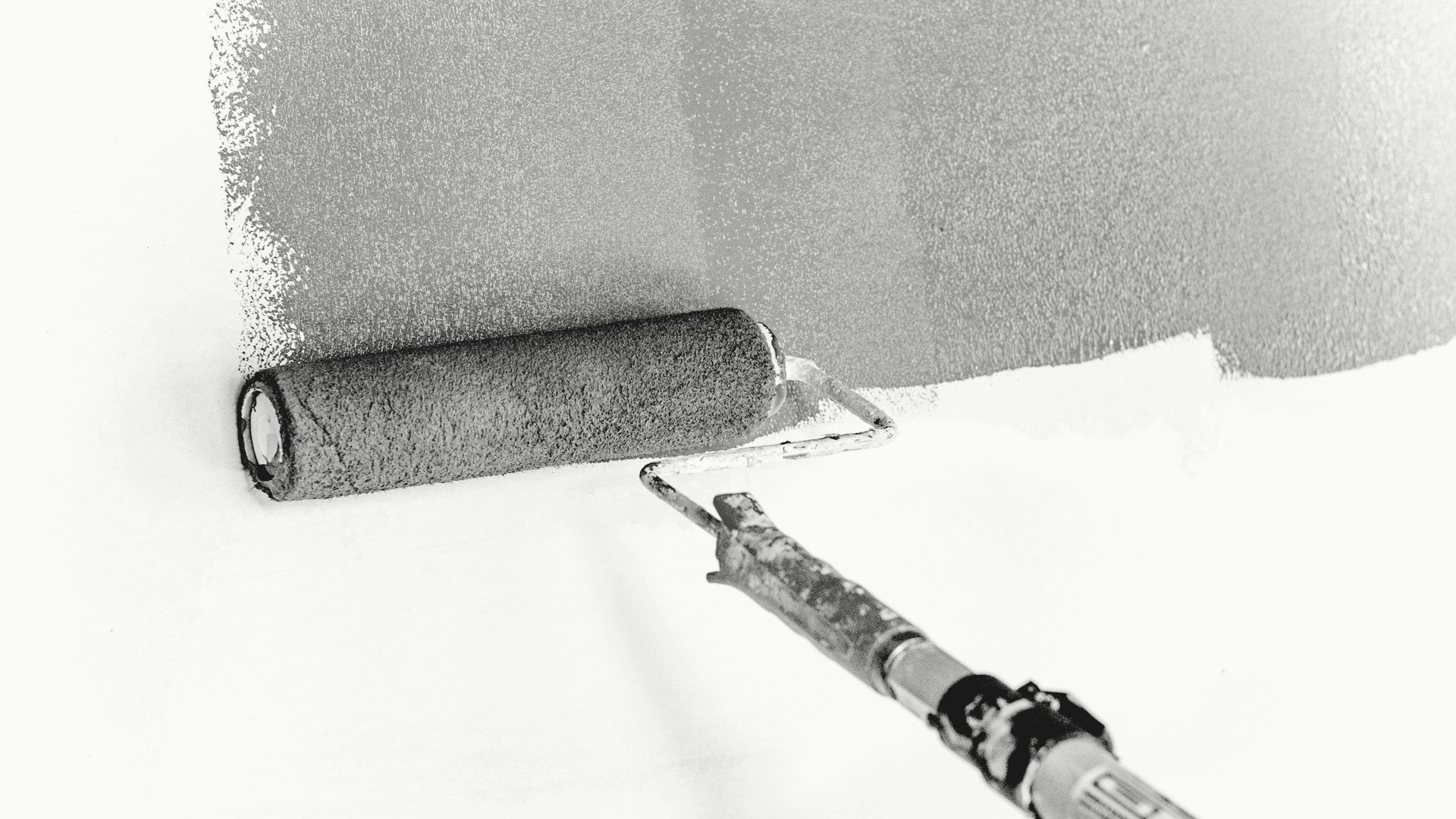
The painter on our Fairfax Avenue turnover last spring was forty minutes into the job when I walked the unit and noticed no primer on the bathroom wall. The drywall patch from the plumber's access was raw—gray compound, fresh skim coat, porous as a sponge. The painter had loaded his roller with color and gone straight to it. I asked him why. He said the primer was an extra step, that his paint was self-priming, that the patch was small. None of those things were true in any way that would matter in eighteen months, when the paint would peel back at every edge like a Post-it note. We stopped the job. We primed.
I tell that story not because the painter was incompetent. He wasn't. He was doing what a large fraction of the trade does—optimizing for speed on a job where the owner isn't watching and where the failure won't be visible until well after the check has cleared. Primer is the easiest thing to skip on a paint job. It adds an hour per room, it costs money, and nobody can tell from the curb whether it was applied. That is precisely why skipping it is so common and why paying attention to it is one of the more reliable edges an operator can hold.
The job that gets done right when nobody's watching is the job that doesn't call you back in two years.— Field note, Fairfax Avenue turnover, April 2026
What primer actually does.
Primer is not a first coat of paint thinned out. It is a bonding agent—a separate chemistry designed to create a mechanical and chemical connection between a surface and the topcoat that follows. Without it, paint sits on top of whatever is underneath instead of locking into it. That distinction accounts for nearly every premature paint failure I've diagnosed on a building we've taken over.
On new drywall, primer seals the porous paper facing so paint doesn't absorb unevenly—the condition that makes a wall look patchy in raking light no matter how many finish coats go on top. On bare wood, it blocks tannin bleed-through, the yellow-brown staining that ghosts through a white topcoat weeks after the job looks finished. On repaired patches—the kind a plumber leaves behind on every access wall—primer equalizes the texture so the topcoat dries at a consistent rate across the surface. On a drastic color change, it prevents the old color from reading through for the life of the new coat.
Skip primer and none of those problems go away. They just move downstream, where they cost more. Stains bleed through. Adhesion fails at seams and edges first. Coverage looks uneven in direct light, and the owner calls the painter back—except by then the painter has moved on to the next job, and getting them back is its own project. We've seen this pattern on at least a dozen buildings we've walked for owners who wanted to understand why their paint jobs weren't holding.
What "self-priming" actually means
Every painter who skips primer will tell you the paint is self-priming. Some paint is, in a narrow sense: on a previously painted, well-adhered, uniform surface, a high-solids paint can bond without a dedicated primer coat. That covers perhaps a third of the situations painters use the claim to justify. It does not cover bare drywall, bare wood, patched surfaces, stucco repairs, or any surface with adhesion questions. On those—which is most of what we encounter on an occupied multifamily building—self-priming is a marketing claim, not a field decision.
The argument contractors make.
The argument against primer is simple: it adds cost. A dedicated primer coat runs an hour per room in labor plus the material—figure $15 to $25 per gallon for a quality shellac-based product, $8 to $12 for a water-based PVA on new drywall. On a twelve-unit repaint, that adds up. A painter working at thin margin on a competitive bid looks at the primer coat and sees the difference between a job that works and one that doesn't.
The argument for primer is equally simple, and it's the one I find more persuasive every year: labor is 70 to 80 percent of the total cost of a professional paint job. The paint and primer together are a rounding error on the overall bill. A primer coat adds an hour to a room. A callback to repaint a room six months after a failed job costs a full day—travel, setup, two coats, cleanup—and that's assuming the contractor honors the warranty. Many don't. Repainting a building three years early because the paint failed under conditions that primer would have prevented costs $4,000 to $8,000 in labor alone, before you count the tenant disruption, the unit downtime, and whatever water damage found its way through the failed film in the interim.
The math only resolves one way. Primer is not a premium. It is the baseline.
The arithmetic on cheap paint.
The same logic extends to paint quality, and the numbers are clearer than most owners expect. Budget paint runs $25 to $35 per gallon. In LA's UV environment it starts fading and chalking within three to five years. Premium paint—we use Dunn-Edwards on our own jobs—runs $50 to $65 per gallon, covers in one to two coats versus two to three for a budget product, and holds color for eight to twelve years before it needs replacement. The solids content tells the story: premium Dunn-Edwards runs 40 percent or more solids by volume, meaning 40 percent of what goes on the wall stays on the wall after the carrier evaporates. Budget paints run 25 to 30 percent. The rest is water.
| Factor | Budget paint ($30/gal) | Dunn-Edwards ($55/gal) |
|---|---|---|
| Coats needed | 2–3 | 1–2 |
| Solids content by volume | 25–30% | 40%+ |
| Paint material cost (avg. 8-unit exterior) | $300–500 | $500–700 |
| Labor cost per job | $3,000–6,000 | $3,000–6,000 |
| Years before repaint in LA conditions | 3–5 | 8–12 |
| 10-year all-in cost | $8,000–18,000 | $3,500–6,700 |
Most operators compare paint by the price on the can. That's the wrong number. The right number is cost per year of protection—and on that metric, the $55 gallon beats the $30 gallon by a factor that isn't close. If you repaint an eight-unit building every four years because the cheap paint fades and chalks, you're paying full labor three times in a decade. Use paint that holds for ten years and you pay it once. The material upgrade from budget to premium on that job costs $200. The labor savings are $6,000 to $12,000. This is not a difficult argument.
Where LA makes it worse.
Los Angeles gets roughly 300 days of sun per year. South- and west-facing walls on a Hancock Park courtyard, a Fairfax mid-block building, or a Bel Air hillside single-family take UV load continuously from April through October, with no meaningful break in the shoulder months either. That load degrades paint film through a process called photo-oxidation—the UV breaks the binder down at the molecular level, which is why cheap exterior paint in LA chalks and fades faster than the same product would in Seattle or Chicago.
Premium paint is formulated for this specifically. The UV-stabilized resins in a product like Dunn-Edwards Evershield aren't a marketing addition—they're the reason the color holds four years past the point where a standard product starts reading as a different shade. On a building with significant south or west exposure, the gap between premium and budget is not twelve years versus five. It's twelve years versus three. I've seen it on our own buildings and on buildings we've walked for owners who couldn't figure out why they were painting more often than the neighbors.
The sun is not a variable here. It is a constant, and it operates on a schedule. The question is whether the paint you put on the wall is rated for it or not.
How we specify the job.
On every Atlas painting project—interior turnover, exterior maintenance cycle, full rehab—the spec is the same. Full surface prep: pressure wash on exteriors, scrape all failing material, sand edges, caulk every seam and penetration. Dedicated primer on all bare surfaces, all repaired areas, and all significant color changes. Premium paint, two coats. No exceptions negotiated on materials; scope can flex, quality doesn't.
The reason we don't negotiate on materials is the same reason we don't negotiate on permits: the callback costs more than doing it right the first time, and the liability for the callback sits with us, not the sub. When we hand a building back to an owner after a repaint and the paint starts failing in eighteen months, we eat the job. That makes the primer coat and the premium gallon an investment in our own margin, not a favor to the owner. I find operators understand the argument much better when it's framed that way.
Three practical moves:
1. Before your next paint job, ask the painter for the spec sheet on the primer they're planning to use. If they look at you blankly, they were not planning to use primer. That is information.
2. On any exterior repaint of a building with south or west exposure in LA, require a UV-stabilized premium product and ask for the solids content by volume on the can. Anything under 35 percent solids on an exterior coat is a three-to-five-year product in this climate, regardless of what the brand says.
3. Run the ten-year math before you approve the low bid. Take the labor cost from the quote, multiply by 2.5 (the number of times cheap paint will require repainting over a decade versus once for premium), and compare that to the material upgrade cost. The arithmetic resolves in under two minutes and will stop you from optimizing for the wrong number.
Nobody wins an argument with a painter by insisting on better primer. The argument doesn't happen, because the painter who uses it doesn't think it's worth arguing about. That is, in the end, the point.
— End of Entry № 056 · Los Angeles, April 21, 2026