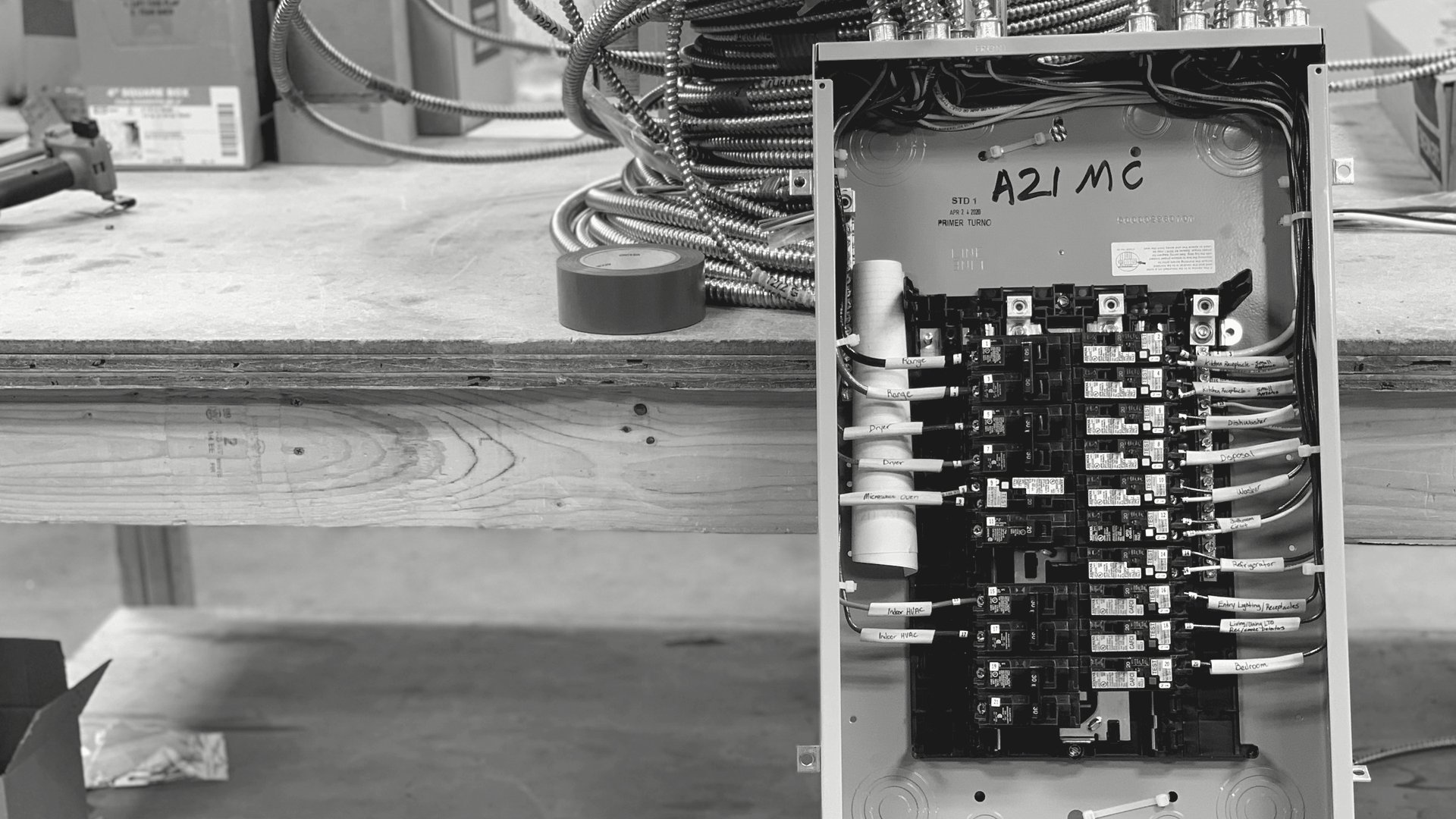
The electrician came out on a Tuesday, walked the panel for eleven minutes, and handed over a number: $3,500, all-in, 200-amp upgrade, permitted, done in a day. The owner called me that afternoon—he owns a 1952 courtyard on the Olympic corridor, eight units, had been quoted by three shops and this was the middle bid. He wanted to know if it was real. I told him to call LADWP before he signed anything. Two days later he had a different picture: the utility-side service entrance needed replacement, the conduit from the meter socket to the new panel location required rerouting, and LADWP's own timeline was four to six weeks minimum. The all-in number was $6,900. The cheap bid had simply omitted everything the electrician does not control.
This is the canonical LA panel upgrade story. It runs on every block in Hancock Park, Miracle Mile, and Larchmont, on every hillside single-family in Hollywood Dell, and on every 1960s Mid-Wilshire fourplex where the original 100-amp box is still doing its best. The first number you hear is for the electrician's scope. The real number includes the utility, the inspector, and whatever the walls are hiding.
The permit line on a panel upgrade isn't paperwork. It's the thing that makes the work legal when you sell — or when it burns.— Field note, February 2026
Why the first number is always wrong.
Roughly 40 percent of homes in neighborhoods like Hancock Park, Miracle Mile, and Larchmont are still running 100-amp panels installed in the 1950s and early 1960s. That infrastructure was sized for a refrigerator, a television, and overhead lights. It was not sized for an EV charger drawing 32 amps on a dedicated circuit, a heat pump pulling 30 amps, and a modern kitchen running simultaneously. The math doesn't close. The panel has to come out.
When an owner calls for an upgrade quote and gets a number like $2,500 to $3,500, that number typically covers one thing: the electrician's labor and material to swap the panel and land new breakers. It does not cover what LADWP charges to upgrade the meter socket or service entrance—which is triggered whenever the panel ampacity changes. It does not cover the LADBS permit, which is required for any panel replacement in the City of Los Angeles and runs $150 to $350 depending on valuation. It does not cover the post-installation inspection, and it does not cover any access work—trenching, conduit rerouting, concrete patching—that turns up once the old panel comes off the wall.
None of this is the electrician's fault. Shops quote what they control. The problem is that owners read a single-line bid as a total project cost, and they are wrong by $1,500 to $4,000 before the job starts.
What the job actually contains.
A complete 200-amp panel upgrade in Los Angeles has five distinct cost buckets. Here is how they break out on a typical occupied single-family or small multifamily, based on jobs we have done and overseen on the Westside and Mid-Wilshire over the past eighteen months.
| Line item | Low | High | Notes |
|---|---|---|---|
| Panel + breakers (material) | $800 | $1,500 | Siemens, Square D, or Eaton; 200A main breaker included |
| Electrician labor (6–10 hrs) | $1,200 | $2,000 | Licensed journeyman; burdened rate |
| LADBS permit + inspection | $150 | $350 | Required for all panel replacements in City of LA |
| LADWP meter / service upgrade | $0 | $1,500 | Triggered when ampacity changes; 4–6 week LADWP lead time if needed |
| Access, conduit, trench, patch | $300 | $1,800 | Routing from street to new panel location; concrete or stucco repair |
| All-in typical range | $2,500 | $7,150 | Occupied LA residential, 2026 |
The spread between $2,500 and $7,150 is real, and it is not because some electricians are gouging. It is because the access and LADWP variables are genuinely unknown until you open the wall and call the utility. A 1940s Hancock Park bungalow where the existing service entrance drops cleanly into a new panel location comes in at the low end. A 1958 Miracle Mile fourplex where the meter is mounted on a wall three feet from a property line, the service entrance conduit has to run fifteen feet to clear a structure, and the concrete pad needs cutting and patching comes in at the top.
When the subpanel enters the picture
If the building has a detached garage that is being converted to an ADU—or if the main panel is in the garage and a second distribution point is needed in the main structure—add $500 to $1,200 for a subpanel installation. That work also requires its own permit line and its own inspection visit. We include it as a separate line item on every quote we write, because owners who don't see it in writing tend to assume it was included in the main panel number.
The LADWP variable no one quotes.
The utility coordination piece is where most LA panel upgrades go sideways on budget and timeline. Here is how it works in practice.
LADWP owns everything from the transformer on the pole to the meter socket—the utility side. The licensed electrician owns everything from the meter socket to the panel—the customer side. When you upgrade from 100 to 200 amps, you are changing the ampacity of the service. LADWP has to be notified, and in many cases the utility will require upgrading the meter socket, the service entrance cable, or both. That work is either done by LADWP directly (and billed to you) or by a licensed electrician working to LADWP specifications under a separate service order.
In a clean scenario—newer construction, accessible meter, no existing deficiencies—the LADWP coordination costs nothing and adds two to three weeks to the schedule for the utility to come out and reconnect after the panel swap. In a complicated scenario—older service entrance, meter in a non-standard location, overhead drop that needs lowering—you are looking at $500 to $1,500 in utility-side work and four to six weeks of LADWP lead time before the job can close.
No electrician can quote you the LADWP number on the phone. Anyone who does is guessing. The right answer is: call LADWP's service planning line before the electrician even starts, describe the project, and get a scope in writing. It costs nothing and saves three weeks of schedule surprise after the panel is already off the wall.
Federal Pacific, Zinsco, and the panels that should already be gone.
There is a subset of LA panel upgrades where the question is not "do I need to upgrade?" but "why hasn't this been replaced already?" Federal Pacific Electric and Zinsco panels—installed in thousands of LA homes and small multifamily buildings between 1950 and 1985—have a documented failure-to-trip rate. The breakers do not reliably interrupt current during an overload. That is the one thing a breaker is supposed to do.
FPE Stab-Lok panels are the most widely documented. Studies commissioned over the past two decades have consistently found trip failure rates that would be unacceptable on a modern panel. Zinsco panels—sold under the GTE-Sylvania name in some markets—have a similar failure mode at the bus bar connection. If you own a building with either panel and you have not replaced it, you are managing a known fire risk, and the question of cost is secondary to the question of liability.
We pull FPE and Zinsco panels when we encounter them, regardless of whether the owner called us for an upgrade or for something else. I am not raising this to sell work—I am raising it because any cost article about LA panel upgrades that omits these two brands is leaving out the most important sentence in the document.
How to read an estimate before you sign it.
A panel upgrade quote that comes to you as a single number is not a quote. It is a floor. Here is what a real line-item estimate should show, and what to do if yours does not.
1. The estimate should list material and labor separately. "Panel + breakers" and "electrician labor" are different cost buckets with different markup structures. If they are combined into one number, ask for the split before you sign.
2. The permit line should be explicit. "Permit included" buried in a paragraph is not enough. You want the LADBS permit application fee shown as its own line, and you want confirmation that the electrician is pulling the permit—not advising you to pull it yourself. Unpermitted electrical work in the City of Los Angeles creates a disclosure obligation on sale and a liability problem in the event of a loss.
3. The LADWP coordination scope should be addressed, even if its cost is TBD. A responsible electrician will tell you: "I cannot quote the LADWP side until we confirm the service entrance condition, but here is what I expect." That sentence is a sign of someone who has done this job before. Its absence is a sign of someone who is going to invoice you for it later as a change order.
4. Access and patching should be addressed. Conduit rerouting, trench work, stucco or concrete repair—if the electrician has not walked the exterior of the building and commented on the service entrance path, the quote is incomplete. On a Westside job with a concrete pathway between the meter and the panel, the trench and patch alone can run $800 to $1,200.
Three practical moves:
First, before you invite anyone to quote the panel, call LADWP's service planning line and describe the upgrade. Ask whether the service entrance or meter socket will need to be replaced, and what LADWP's current lead time is for service orders in your area. That call takes twenty minutes and tells you whether you have a four-week job or a ten-week job before a single electrician sets foot on the property.
Second, require a line-item quote from every shop you invite—not a flat number, not a range, but a breakdown by the five cost buckets listed in Fig. 01 above. If a shop won't break it out, cross them off the list. You've learned what you needed to learn.
Third, build the permit cost and LADWP contingency into your budget from day one. On a straightforward job, the LADWP line is zero. On a complicated one, it is $1,500. Budget the high end, and if you come in under, you come in under. The alternative is discovering the number mid-job, when the old panel is already in the dumpster and the building is running on a temporary service.
— End of Entry № 053 · Los Angeles, April 21, 2026