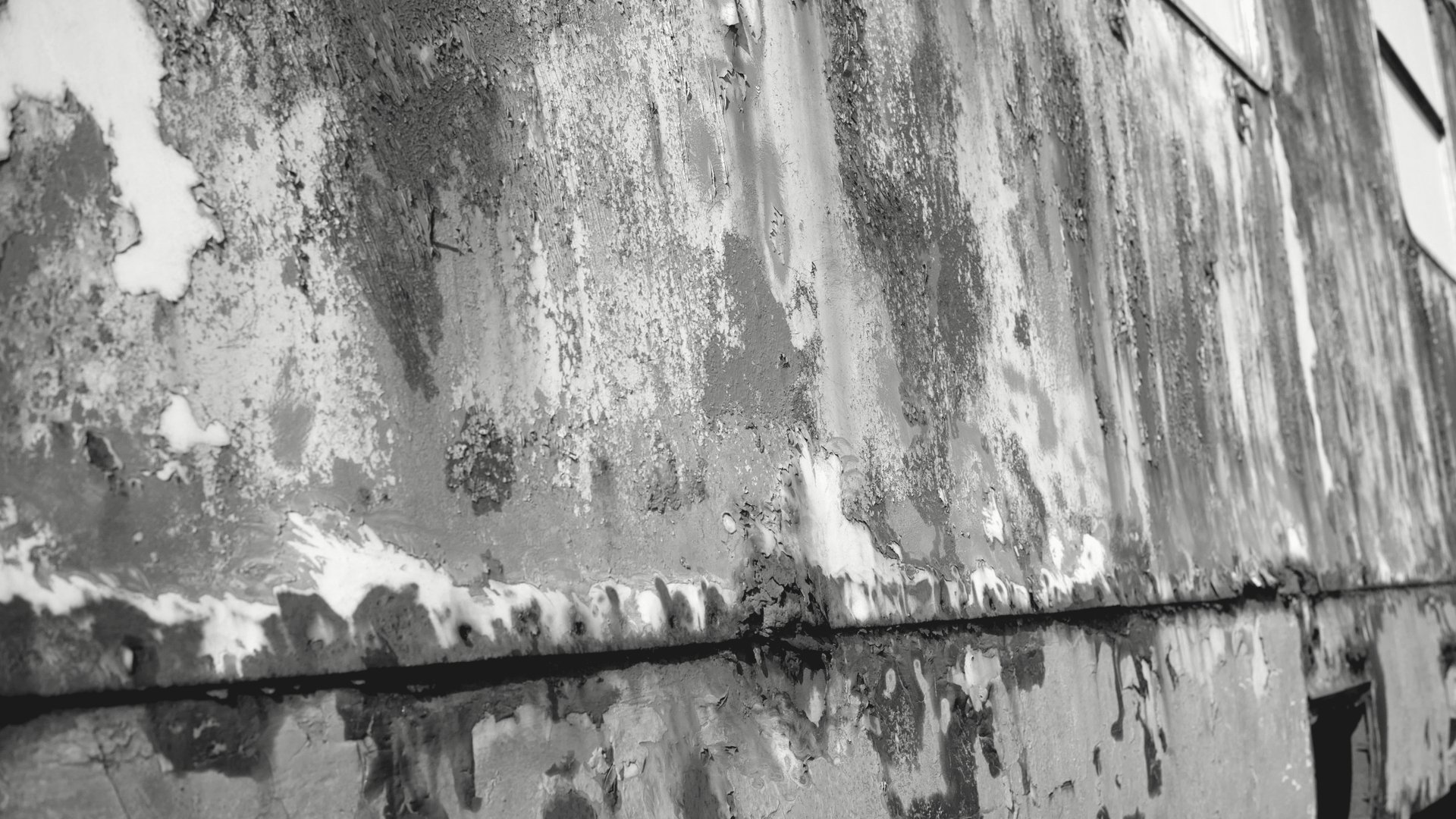
A painter we use in Mid-Wilshire walked a 1940s courtyard with me last spring and pointed at a section of wood siding near the second-floor walkway. The paint looked fine from six feet away — a little dull, nothing alarming. He pressed his thumb against it and the surface flexed. The paint film had separated from the wood underneath. Water had been sitting behind it for at least one rainy season, maybe two. The wood itself hadn't rotted yet. But another winter and it would have.
The owner had been watching the paint and waiting for it to look bad. By the time paint looks bad, the job it was doing is already over. That's the category error most operators make, and I've made it myself on buildings I should have known better on. Paint is not decoration applied to a building that is otherwise protected. Paint is the protection.
You're not painting a building that needs to look better. You're waterproofing a building that needs to stay dry.— Field note, painter conversation, Mid-Wilshire, April 2025
The argument most owners make wrong.
The standard owner calculus goes like this: the building looks okay, the tenants haven't complained, and a full exterior paint on a six-unit courtyard runs $8,000 to $15,000 depending on condition and prep. That's real money. So you defer it until it looks obviously bad, at which point you're not wrong to spend the money.
The problem with this logic is the phrase "looks obviously bad." Paint doesn't fail all at once. It fails slowly, from the inside out, in the places you aren't watching — the north-facing walls, the sections under the eave overhang, the trim joints where caulk has let go. By the time it looks bad to you standing on the sidewalk, the barrier has been compromised for somewhere between one and three years in a typical Los Angeles climate. The building has been taking moisture the whole time.
I am not arguing for panic repaints every two years. I'm arguing for treating paint as a maintenance cycle with a real interval, like an HVAC service or a roof inspection — something on the calendar with a cost you plan for, not a cost that appears after the damage is already done.
What paint actually does to a building.
Wood siding is not waterproof. Stucco is not waterproof. Neither is the trim, the fascia, the soffits, or the exposed framing at any penetration point on the envelope. Paint is the waterproofing layer. When it fails — through UV breakdown, mechanical cracking at joints, or simple age — water finds its way into the substrate and stays there.
What happens next is predictable and expensive. Moisture in wood triggers rot from the inside. It doesn't announce itself until the wood has lost structural integrity, at which point you're not painting over a problem — you're cutting it out and replacing it first. Moisture in stucco migrates to the lath and the framing behind it, where it can run along a wall plate for twelve feet before showing up as a water stain on an interior wall two rooms away. By then, the diagnosis involves opening walls.
The cost equation is simple and brutal. A timely exterior paint job on a six-unit West LA courtyard runs $8,000 to $15,000, including proper prep. The same paint job deferred until wood rot is visible — rot that a timely paint cycle would have prevented — runs $13,000 to $30,000, because you are now paying for both the paint and the repair beneath it. That gap is not hypothetical. We see it on jobs we inherit from owners who were watching the paint and waiting for it to look bad.
The prep question nobody asks upfront
The difference between a paint job that holds for eight to ten years and one that fails in four is almost entirely in the preparation — not the paint product. Proper prep means pressure washing, full scraping of any failed film, caulking every seam and penetration point, primer on bare wood before topcoat, and a moisture check before application. Painters who skip prep produce work that looks fine for eighteen months and then delaminate from underneath.
When you're getting bids, ask specifically what the prep scope includes. If the answer is vague — "we'll clean it up and get it ready" — you have your answer. The painters who will give you a paint job that lasts are the ones who can tell you, line by line, what they're doing before the first coat goes on.
The coastal zone problem.
Everything above applies to any West LA building. But if you own in Venice, Santa Monica, Pacific Palisades, or anywhere west of Lincoln Boulevard, the timeline compresses and the argument for a maintenance schedule gets stronger.
Quality exterior paint on wood siding in an inland LA neighborhood — Hancock Park, Fairfax, Mid-Wilshire, Hollywood Dell — lasts seven to ten years under normal conditions with good prep. In the coastal zone, reduce that by 20 to 30 percent. The salt air off the ocean accelerates paint degradation in ways that are not visible until the barrier is already compromised. You don't smell it failing. You don't see it failing. It fails in the film chemistry, and the first sign is often the same thing our painter spotted in Mid-Wilshire: a surface that looks intact but has lost adhesion to the substrate underneath.
An owner in Pacific Palisades who is running on a ten-year repaint cycle for a property that needs seven is running a three-year window of unprotected substrate every cycle. Across twenty years of ownership, that's six years of intermittent moisture intrusion. The repair costs that come out of that aren't dramatic in any single year — they show up as a persistent overhead of rot repairs, caulk failures, and interior water stains that you never quite get ahead of. We have seen this pattern on Palisades and Brentwood hillside properties where the owners were not negligent, just on the wrong cycle.
Where deferred paint turns into structural money.
The failure modes that cost the most are also the hardest to see coming. Here are the three we encounter most often on LA properties that deferred their exterior cycles too long:
1. Fascia and soffit rot at roof edges. The overhang is the one place on a wood-frame building that takes moisture from above and below simultaneously — rain from the roof, condensation from the attic. Paint here fails faster than on vertical surfaces, and rot in a fascia board is never isolated. By the time you replace a fascia board, you're usually replacing the one next to it and inspecting the rafter tails behind both. A Hancock Park single-family job we did in 2024 ran $4,200 in fascia and soffit replacement before the painter could touch the surface — all of it preventable with a repaint two years earlier.
2. Window and door frame infiltration. Caulk at window and door frames cracks and shrinks as it ages, and paint failure at those joints accelerates the process. Water that gets behind a window frame migrates into the rough opening and sits on the rough sill — horizontal framing that doesn't dry quickly. Replacing a rotted rough sill means pulling the window, reframing, and reinstalling. That's a $1,200 to $3,000 repair per opening, depending on size and access, not counting the window reinstall. A caulk-and-paint maintenance cycle catches this at the seam, not at the framing.
3. Stucco delamination on older buildings. On 1930s and 1940s courtyard buildings — the standard Westside multifamily stock — stucco was applied over wood lath in a three-coat system. When the paint on top of that stucco fails and moisture gets in, the lath behind the stucco absorbs it and swells. The stucco cracks from behind. By the time you see a stucco crack on the exterior, the lath underneath may have been wet for two seasons. Patching stucco on the surface costs $300 to $800 per section. Replacing stucco with failed lath behind it costs $25 to $40 per square foot of wall surface, including demo, new lath, three-coat system, and finish paint. These are not edge cases on older LA multifamily. They are the standard failure trajectory when paint is treated as cosmetic.
How to repaint on a schedule, not a crisis.
The practical shift is not complicated. It is a calendar change, not a budget change — because the money is spent either way. You either spend it on the paint cycle, or you spend it on the paint cycle plus the repair work underneath it. I have never seen a building where deferral saved money on a net basis. The question is always just when the bill arrives and how large it has grown by then.
Three practical moves:
1. Set a repainting interval in writing and put it on your maintenance calendar. For a wood-frame building in an inland West LA neighborhood, seven to eight years is a reasonable exterior cycle. For anything west of Lincoln Boulevard, five to six years. Write it down. It's easier to spend $10,000 on a planned repaint than $10,000 on an emergency repaint plus $8,000 in rot repairs that only happened because you were six months past your interval.
2. Walk the envelope annually with someone who knows what failing paint looks like. A painter you trust, a GC, a property manager with real field experience. The visual check you do from the sidewalk doesn't catch soffit delamination, caulk failure at penetrations, or the early-stage adhesion loss our Mid-Wilshire painter found with his thumb. An informed eye catches these things at eighteen months of failure, not at four years.
3. When you do repaint, require a written prep scope before you accept a bid. The prep is where a ten-year paint job gets built. If the bid you're looking at doesn't specify scraping, caulking, priming, and a moisture check, the contractor is quoting you a two-coat cover-up, not a maintenance cycle. Those are different products with different lifespans. Price them differently.
Paint is infrastructure. It has a service life, a replacement interval, and a repair cost when it fails. It belongs in the same mental category as the roof, the plumbing, and the electrical panel — not in the category of curb appeal upgrades you get to when the building looks bad. Treat it like maintenance, and the math works clearly in your favor. Treat it like cosmetics, and you'll spend the same money later, plus the cost of everything that failed in the meantime.
— End of Entry № 057 · Los Angeles, April 21, 2026