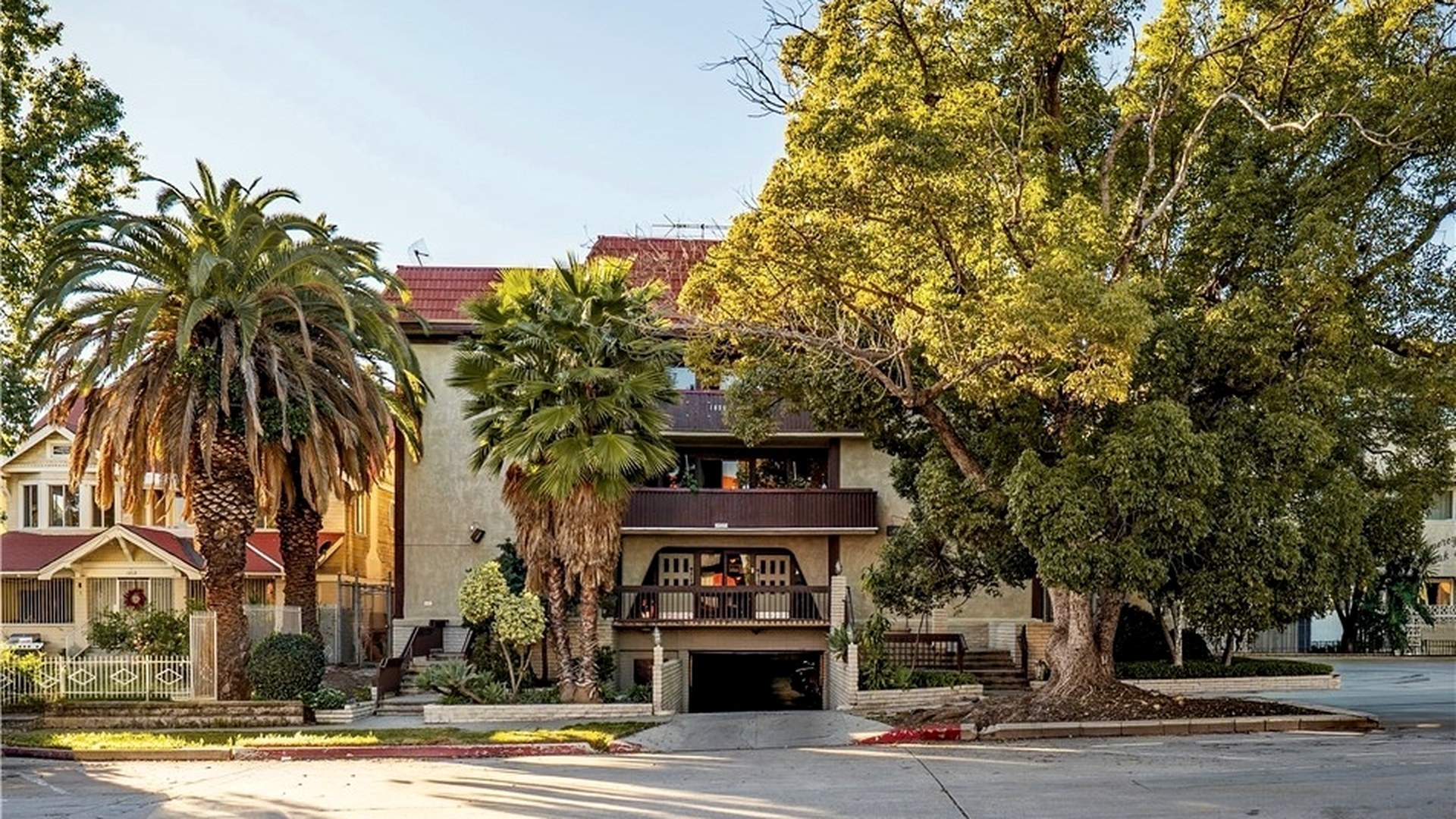
A twenty-seven-unit 1968 multifamily at 1825 North Gramercy Place just closed at $5,050,000. That works out to $187,037 a door on units averaging 1,077 square feet, with a building basis of $173 a square foot. This looks like one of the best deals I have seen trade in Los Angeles in months, and it is worth writing down exactly what that means and what it does not.
The property is Hollywood, not the best location. North Gramercy sits east of Western, near Franklin, in the kind of half-transitional Hollywood block where a good operator can create value over the next decade. The units are large for 1968 LA stock, sitting at an average 1,077 square feet for two-bedroom plus den floor plans. It listed at $5,300,000. It sold for $5,050,000. That $250,000 bid-ask is itself a story, and I will get to it.
$187 a door, 1,077 a unit, 1968 concrete, this is what a real basis looks like in 2026 Los Angeles.Field note, April 2026
The number that got my attention.
I track LA multifamily trades weekly, and the per-door number on Hollywood vintage product has been sticky in the $220K to $280K range for anything comparable. Seeing a 27-unit asset trade at $187,037 a door is not normal. It is the kind of basis you get when a motivated seller meets a patient buyer in a downward market, and when the asset has enough hair on it that it didn't scare off this investor.
The per-square-foot number is even sharper. $173 a foot on a building that is already standing, parked, and permitted in 1968 is below anything I have seen and with replacement costs for new being closer to $400-500 a SF, this might be a great bargain. Great value on cost per sf and per unit basis. That is what makes this a basis trade, not a yield trade. You are paying for the bricks, and the income is almost a free option.
Reading the GRM to a 6-cap.
Back of envelope, this looks like it traded at a 9.3 gross rent multiplier. The way I read 9.3 GRM on Hollywood vintage product in 2026, with a good operator taking the management and repairs over, is roughly a 6-cap today. Maybe 5.8 if insurance has not been repriced at renewal yet. Maybe 6.2 if the prior operator was half-asleep on expenses and the new owner tightens the expense stack.
A 6-cap on a 27-unit Hollywood asset with 1,077-square-foot units and a $187 basis is, frankly, an interesting entry. You do not often see both basis and going-in yield this honest on the same line. The frozen LA buyers are looking for signs of a bottom in the market, signs of better policies and seeing if Trump can get the rates down. This operator is looking at a 6 cap going in on day one.
On financing: strong operator money is still clearing at roughly 5.3 to 5.7 percent right now, even after the 10-year Treasury moved up roughly 30 basis points on the Iran War repricing. That is not cheap, but it is debt that works on a 6-cap entry if you are not over leveraging. DSCR at 5.5 percent interest on a 65 percent LTV loan against this asset at its new basis is a number an operator can do well with through the cycle and possibly raise rents, turn some units and refinance in the next few years.
| Line | Figure | Note |
|---|---|---|
| Purchase price | $5,050,000 | Closed Apr 10, 2026 |
| Per-door basis | $187,037 | 27 units |
| Per-SF basis | $173.63 | 29,085 SF total |
| Reported GRM | 9.3× | Estimated from basis & market rent |
| Implied going-in cap | ~6.0% | Good operator, expense discipline |
| Market debt, 65% LTV | 5.3-5.7% | Post-Iran repricing |
| Day-one spread over debt | ~30-70 bps | Thin but positive |
One caveat on every number in that table. A recorded sale gives you the purchase price and the square footage. It does not give you the in-place rent roll, the trailing twelve expense line, or the soft-story retrofit status. My 9.3 GRM and 6-cap reads are operator-side estimates from comparable Hollywood vintage product and are worth exactly what you paid to read them. If you are thinking about following this buyer in, do your own T-12 work, verify the soft-story compliance, and price insurance to renewal, not to the prior owner's policy. The basis is real. The yield is only as real as the rent roll that supports it.
The ULA line, and why the policy needs to be fixed for multifamily.
Here is the honest context. The sale closed at $5,050,000, which is $250,000 below the $5,300,000 list. The United to House LA transfer tax, ULA, was passed by LA voters in 2022 and triggers at a 4% rate for transactions at $5,300,000 or above for multifamily. Above that number, a trade carries a $212,000+ tax at the threshold alone. Below that number, it carries zero.
I don't know the particulars of how the Gramercy number was negotiated, and I'm not going to guess. What I do know, from watching the LA multifamily market since ULA passed, is that the policy is freezing middle-market trades and that is bad for owners, brokers, operators, and tenants alike. The spirit of the measure was to fund affordable housing by taxing luxury real estate. The practical result is that rental housing owners, many of them family-held, multi-generational portfolios, are being hit with a tax rate that makes routine sales and recapitalizations far harder to get done.
ULA should be amended to exempt or carve out multifamily rental housing from the 4% trigger. The current structure discourages ownership transitions, discourages the recapitalization of older buildings that need capital improvements, and ultimately hurts the tenants it was designed to help. A cleaner framework would apply the tax only to non-residential and true luxury single-asset trades, and leave rental housing alone. This is a reform worth pushing for. In the meantime, disciplined operators, brokers, and owners continue to find ways to get deals done responsibly and within the rules.
The Gramercy trade cleared at a clean number below the ULA threshold. That is a win for the seller, who got liquidity. It is a win for the buyer, who picked up a solid asset at a defensible basis. It is a win for the brokers on both sides, who earned their fees. And it is a signal to every LA multifamily owner watching the board: trades are happening, priced honestly, and the operators with long-term conviction are still showing up.
What an operator takes this to in ten years.
The real reason this trade is interesting is not the entry. It is the exit. At a $187K/door basis with a roughly 6-cap going in, a patient operator has room to take this asset to an 8-cap on their own basis over five to ten years just by operating it well. That means: in-place rent growth as turnover happens, the operator lowers costs, a careful capital plan that addresses the 1968 infrastructure without gold-plating it, and insurance underwriting that does not crush the expense line every renewal. Some bigger operators are consolidating their policies with one insurance company and lowering costs.
Here is what the leverage math looks like if the buyer put this together the way a disciplined LA operator would.
Assume the buyer put down approximately 35% ($1.77M) and financed the balance ($3.28M) at a mid-6% fixed rate on a 30-year schedule. NOI of roughly $305,000 against annual debt service of around $246,000 leaves about $59,000 of levered cash flow in year one, a roughly 3.3% cash-on-cash start.
Now run the next ten years with three things going in the operator's favor. One, rates drop at least 100 to 150 basis points over the hold, enabling a refinance in year three or four that lowers debt service. Two, ULA is amended to stop penalizing multifamily transactions, unfreezing the pricing comps above $5.3M. Three, rents compound at a modest 3 to 4% annual on the non-regulated portion of the rent roll as turnover normalizes.
Under that path, cash-on-cash climbs steadily. By year three after a refi, it's into the mid-single digits. By year five, with rent growth and expense discipline, the asset is producing cash-on-cash yields at or above 8% on original equity, and that number grows every year from there. At year ten, on an 8-cap exit that reflects a stabilized operation and a healthier LA market, the total return, including the principal pay-down and the cash flows along the way, produces an IRR in the 17% range on original equity. Patient capital, disciplined operations, and a market that eventually gets out of its own way.
This is illustrative, not a guarantee. Rates could move the wrong way, ULA could stay in place, and rent growth could stall. But the shape of the opportunity, a basis-driven entry that compounds through a decade of operation, is the real reason a buyer writes a check at 1825 Gramercy today.
If Los Angeles policy cooperates, and that is a material "if", there is an argument for getting this asset to a 10-cap on the operator's basis inside a decade. That would require three things. First, that rent growth in Hollywood vintage product returns to its long-term trend line rather than the flat-to-negative path of the last eighteen months. Second, that Sacramento and City Hall do not add another layer of rent regulation or just-cause expansion that compresses the growth. Third, that insurance premiums stabilize, right now we are running roughly 10 percent annual increases on older LA stock, and at that compounding rate, insurance alone will eat 150 to 200 basis points of cap rate over ten years if nothing gives.
The three things that could break the thesis.
I am not writing this as a recommendation. I am writing it as the way I read a comp when a good number crosses my desk. Three things could break the thesis on a trade like this, and any owner-operator thinking about following the buyer into Hollywood vintage product at $187 a door should stress each one.
1. Rent growth stays flat or goes backwards. If LA multifamily rents continue same-store flat through 2026 and 2027, the 6-cap today is the 5.5-cap in three years after expenses creep and insurance reprices. The path to an 8-cap requires modest rent growth, not miracle rent growth, but it requires some.
2. Insurance keeps compounding at 10 percent a year. Older Class-C LA stock is being repriced by carriers every renewal, and the increases have been structural, not cyclical. Ten percent a year on a line item that is already 12 to 15 percent of gross income is not a tenable trend over a ten-year hold.
3. City policy adds another leg. The soft-story retrofit ordinance, just-cause eviction rules, rent cap expansions, and the threat of further transfer-tax adjustments are all live risks. Any single one can make this basis look cheap in five years. More than one, stacked, could make it look right-priced.
None of those three are reasons not to underwrite trades like this one. They are reasons to underwrite trades like this one carefully, with a real reserves line, and with an exit that is not dependent on market beta.
For the scan-the-tape operator, the two trades to hold in the same field of view this month are this one and 1101 W 45th in 90037. Gramercy is Hollywood, 1968, basis-and-patience. 1101 is Historic South Central, 1920s, income-and-basis. Both cleared at numbers that made sense to a disciplined buyer on day one. They are not substitutes. They are two sides of the same thesis, which is that sub-$5M trades on older LA stock, priced honestly against the law as it actually reads, are the deals that work this cycle.
$187 a door, 1,077 a unit, 1968 concrete, one step under ULA. If you are scanning the tape for the next trade to learn from, this is one I would put a pin in.
, End of Entry № 01 · Los Angeles, April 20, 2026