Tankless Water Heaters: Are They Worth It in LA?
Tankless systems promise endless hot water and 20% energy savings. We break down the real costs, the math that matters, and when a tank is actually the better call.
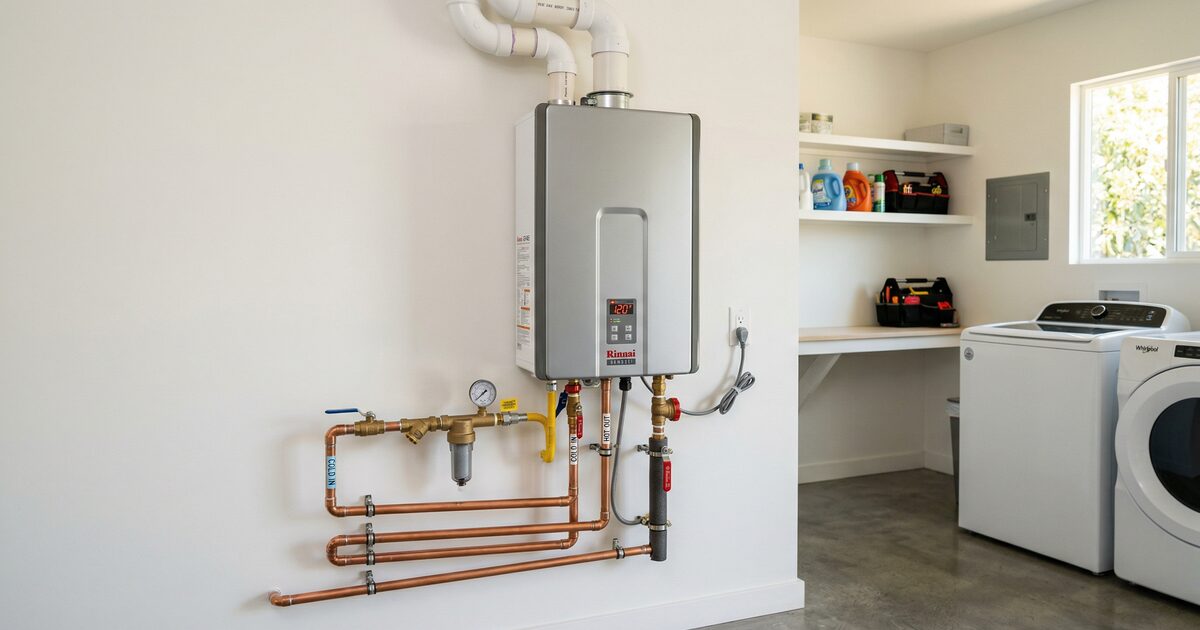
Tankless water heaters are the most-asked-about plumbing upgrade in Los Angeles right now. The pitch is compelling: endless hot water, 20% lower energy bills, and a unit that lasts 20 years instead of 10. But the real question isn't whether tankless is better — it's whether the math works for your specific home, your family size, and your existing plumbing setup.
How Tankless Systems Actually Work
A traditional tank water heater keeps 40–60 gallons of water hot 24 hours a day, whether you're using it or not. That's called standby heat loss, and it accounts for 20–30% of your water heating energy. A tankless unit heats water only when you turn on a faucet — cold water flows through a heat exchanger, gets heated instantly, and flows out hot. No stored water, no standby loss. The trade-off: tankless units have a maximum flow rate, usually 5–8 gallons per minute for a whole-home gas unit. If you're running two showers and a dishwasher simultaneously, a single tankless unit may not keep up.
The Real Cost Breakdown in LA
Here's where the marketing pitch meets reality. A quality tankless unit (Rinnai, Navien, or Noritz) costs $1,200–$2,200 for the unit alone. Installation in LA runs $1,500–$3,500 depending on whether your home needs a gas line upgrade, new venting, or electrical work. Total installed cost: $2,700–$5,700. Compare that to a traditional 50-gallon tank water heater: $800–$1,500 for the unit, $500–$1,200 for installation. Total: $1,300–$2,700. The tankless premium is roughly $1,400–$3,000 upfront.
When Tankless Makes Sense — And When It Doesn't
Tankless is the right call if: your household uses less than 60 gallons of hot water per day (1–3 people), you're replacing a tank that's already failed and need to choose anyway, your home has a gas line that can support the BTU load, or you plan to stay in the home 7+ years to recoup the investment. Tankless is probably not worth it if: you have a large family running 3+ hot water fixtures simultaneously, your home would need expensive gas line or electrical upgrades, or your current tank water heater is under 8 years old and working fine.
Many older LA homes have 1/2-inch gas lines that can't supply the BTU demand of a whole-home tankless unit. A gas line upgrade adds $500–$1,500 to the project. Always get this assessed before committing to tankless.
| Factor | Traditional Tank | Tankless |
|---|---|---|
| Installed cost | $1,300–$2,700 | $2,700–$5,700 |
| Monthly energy cost | $35–$55 | $25–$40 |
| Lifespan | 8–12 years | 18–22 years |
| Hot water supply | 40–60 gal, then wait | Unlimited (flow-limited) |
| Space required | Large closet/garage | Wall-mounted, compact |
| Maintenance | Annual flush ($100) | Annual descale ($150–$250) |
| Best for | Large families, high simultaneous demand | Small-medium households, efficiency-focused |
The question isn't 'Is tankless better?' — it's 'Does the math work for my house?' A 2-person household in a 1,400 sq ft Miracle Mile bungalow is a totally different calculation than a 5-person family in a 3,200 sq ft Hancock Park home.
What About Hybrid Electric (Heat Pump) Water Heaters?
There's a third option gaining popularity in LA: hybrid heat pump water heaters. These use electricity to move heat from the surrounding air into the water — like a reverse air conditioner. They're 2–3x more efficient than standard electric tanks, qualify for federal tax credits (up to $2,000 under the Inflation Reduction Act), and cost $1,800–$3,500 installed. The catch: they need space (a garage or large utility closet) and they cool the surrounding air by 2–5°F, which is fine in an LA garage but not ideal in a small indoor closet.
Considering a tankless water heater?
Free estimates on tankless installation across West LA. We'll help you pick the right system for your home and budget.